
What to write on a headstone
For many families, choosing the words for a headstone or grave marker are some of the shortest, yet hardest things to write.
The short version
Most headstones hold the same few details plus one short line that says who they were.
- Start with the basics: full name, and the years or full dates of birth and death.
- Add a relationship line if you like, such as "Beloved mother and grandmother".
- Choose one short epitaph: a phrase they often said, a faith line, or a few words about their spirit.
- Keep it short. Every letter is carved and takes space, and most stones fit only a few lines.
- Check the cemetery's rules on size, wording, symbols and attachments before you order.
- Read the final proof out loud with family and check every spelling and date.
- For the rest of their story, think about a memorial page the stone can lead to.
Choosing the words for a headstone can feel like the hardest writing you will ever do. The space is small, the words are permanent, and everyone in the family may have a different idea. It helps to know that there is no single right answer. A good epitaph simply sounds like them, or like your love for them.
This guide starts with what usually goes on a stone, then gives short epitaph ideas you can use or adapt, and ends with a checklist for the proof.
What usually goes on a headstone
- Full name. Many families include the middle name or initial, a maiden name, or a well-known nickname in quotation marks.
- Dates. Either the years only (1948 to 2025) or the full dates of birth and death. Full dates take more space.
- Relationship line. Words like "Beloved wife, mother and grandmother" or "Devoted husband and father".
- Epitaph. One short line or verse. This is the part families think about most.
- Symbols. A cross, a star, praying hands, a flag, a hobby or trade. Your monument company will show you what they can carve.
- Military service. Branch, rank and conflict, if the person served. Veterans may also qualify for a free government marker or a bronze VA medallion from the Department of Veterans Affairs.
On a companion stone for a couple, the surviving spouse's name and birth year are often carved now, with the death date added later. Ask the monument company how they handle the later carving.
Epitaph ideas by theme
If you're like me, you're probably wondering what is an epitaph? It's a term that is usually only used when someone passes away, so it's not one we hear every day. An epitaph is a short piece of writing, verse, or phrase that honors a deceased person, most commonly inscribed on a gravestone, tomb, urn, or plaque. These short lines are written to be used or changed freely. Most are under ten words, which suits the space on a typical stone.
Love and family
- Forever loved, forever missed
- Loved beyond words, missed beyond measure
- The heart of our family
- Together again
- Always in our hearts
- Our love goes with you
- She gave us roots and wings
- His family was his greatest joy
Faith
- At home with the Lord
- Safe in God's hands
- Until we meet again
- Rest in peace
- Thy will be done
- The Lord is my shepherd
- Asleep in Jesus
- In God's loving care
Peace and rest
- At peace
- Gone home
- Rest easy
- Free at last
- Sleep well
- Peace at last after a life well lived
A life well lived
- A life well lived, a soul well loved
- She made the world kinder
- He never met a stranger
- Lived simply, loved deeply
- Every day was a gift to us
- A good man, a good friend
- She danced through life
Personality, hobbies and humor
- Gone fishing
- Her garden grows on
- Always the life of the party
- Home from the road
- Still telling stories
- Out of the kitchen, never out of our hearts
- Finally caught the big one
For a child or baby
- Our little angel
- Held for a moment, loved forever
- Too beautiful for this world
- Forever our baby
- Small hands, big love
Service and duty
- Served with honor
- Duty, honor, family
- He answered the call
- She served her country and her community
- Mission complete
How to choose the right words
- Ask what they used to say. A phrase they repeated, a sign-off on cards, or a family saying often becomes the most loved epitaph.
- Think about who will read it. Grandchildren visiting years from now, or strangers walking past. What do you want them to know?
- Say it out loud. Short lines read better on stone. If it needs a comma, try a shorter version.
- Look at other stones in the same cemetery. It shows you the style and length that fits.
- If family disagrees, pick one line for the stone and use the others in the obituary, the funeral program or a memorial page.
Rules and practical details to check first
Cemeteries set their own rules, and they vary a lot, especially between public, church and private cemeteries. Ask before you finalize anything.
- Allowed size, shape and material of the stone or marker
- Whether only flat markers are allowed in that section
- Any limits on wording, symbols, photos or attachments
- Who is allowed to install the stone, and any setting or foundation fee
- How long after burial the stone can be placed (some cemeteries wait for the ground to settle)
- How the monument company charges for lettering, since extra lines or letters can add cost
Before you approve the proof
The monument company will send a drawing of the stone. Mistakes on stone are hard and expensive to fix, so take your time.
- Every name spelled correctly, including middle names and nicknames
- Dates checked against the death certificate
- Quotation marks, apostrophes and capital letters where you want them
- The symbol and font you chose
- Two family members have read it, ideally out loud
When a few words are not enough
Most families find that the stone can only hold a name, dates and one line. The stories, the photos, the recipes and the sayings need more room. Many families tell the full story in the obituary (see our guide on how to write an obituary) and on an online memorial page, where relatives can keep adding memories for years.
Give their story a home that lasts
Make a free Turning Hearts memorial with their life story and photos, and let family and friends add memories.
Start a free memorialA Turning Hearts medallion is one way to connect the two. It attaches to the headstone, and when a visitor scans it with a phone camera it opens the person's memorial page, so the few words on the stone lead to their whole story. As with any addition to a headstone, check the cemetery's rules first.
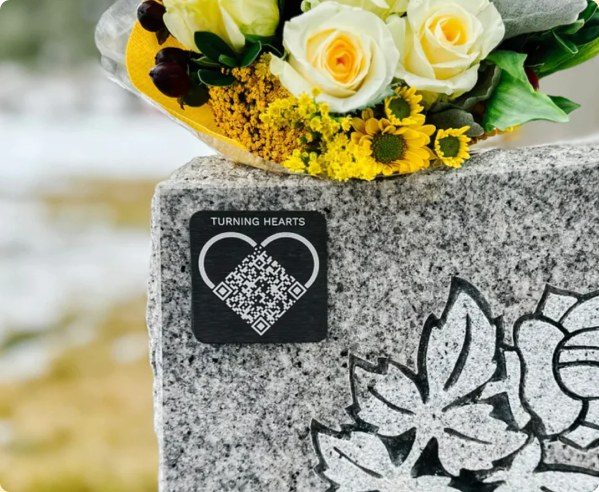
Let their story live at the grave
A Turning Hearts medallion on the headstone lets anyone visiting scan it with a phone and read their life story, see photos and leave a memory.
See the medallionCommon questions
What is the most common thing to put on a headstone?
The full name and the years of birth and death, usually with a relationship line such as "Beloved mother". Many families add one short epitaph, often a faith line or something the person used to say.
How long should an epitaph be?
Short is best, usually one line of under ten words. Every letter is carved by hand or machine, space is limited, and short lines are easier to read from a distance.
Can you put a nickname on a headstone?
Yes. Many families add a nickname in quotation marks between the first and last name, especially if most people knew them by it. Check the spelling and punctuation on the proof.
Do cemeteries have rules about what you can write?
Many do, especially about size, materials, symbols and attachments, and some review the wording. Rules vary by cemetery, so ask the office before you order.
When is the headstone usually placed?
It often takes several weeks to several months, depending on the monument company and the cemetery. Some cemeteries ask families to wait until the ground has settled after burial.